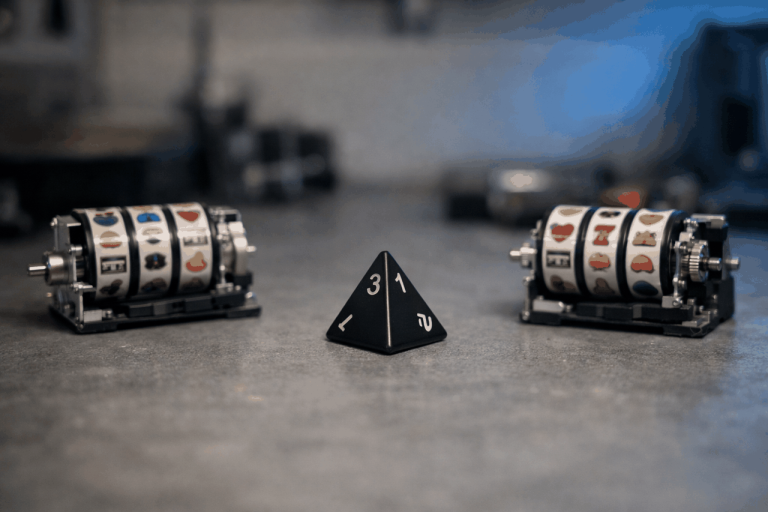
Editorial illustration for the mechanics guide.
Online slot machines accept a play command, use random selection and game rules to determine an outcome, and display the result with any award. A land-based machine can follow the same broad sequence. The important differences are where those steps happen, how random values map to game outcomes, and which configuration governs the game.
The interface does not reveal the architecture. A browser can display a result determined elsewhere, and a networked casino cabinet can act as a client too. Conversely, the presence of a server does not establish that the server selects outcomes. To understand a particular game, follow the command through the equipment and identify the rules behind the display.
Physical Reels and Random-Number Mapping
A random number generator, or RNG, supplies values for the game’s selection process. A mapping connects those values to outcomes under the game’s rules. The symbols are the visible expression of that process; counting them does not necessarily reveal their probabilities.
Inge S. Telnaes’s U.S. Patent 4,448,419, issued May 15, 1984, documents a design that maps randomly selected numbers to stop positions on rotating physical reels. Its abstract and claims 1–2 describe a selectable number set larger than the number of physical stops. Multiple selectable numbers can therefore correspond to the same physical stop.
That distinction matters when looking at a cabinet. A reel may have a limited number of visible stopping positions, while the selection system assigns those positions different probabilities through its mapping. The patent documents a design; it does not establish that a particular current machine uses it.
Architecture Matrix: Follow the Command
The following matrix compares two worked architecture patterns. They illustrate how the parts can fit together, rather than identifying the setup of every online game or casino cabinet.
| Architecture pattern | What receives the command? | Where can outcome logic live? | What maps the selection? | What does the reader see? | Which document identifies the actual configuration? |
|---|---|---|---|---|---|
| Local selection in a physical-reel cabinet | The cabinet’s controls pass the play command to its game controller. | In this worked pattern, the RNG and outcome logic run within the cabinet. | The configured mapping connects random selections to reel stops, and the game rules determine the award. | Physical reels rotate and stop on symbols, accompanied by the machine’s award display. | The machine’s version-specific game documentation, stop mapping, paytable, and installed configuration would be needed. Patent 4,448,419 explains a design, not that installation. |
| Remote selection with a thin client | The client receives the input and sends a play request to remote gambling equipment. | In this worked pattern, remote equipment runs the RNG and outcome logic. | The remote game’s configured mapping and rules determine the outcome and award; the client presents the returned result. | Animated reels and an award display on a browser or networked cabinet screen. | The deployment architecture, component roles, game version, mathematical specification, and active configuration would be needed. General equipment guidance does not identify a particular deployment. |
A cabinet describes the physical interface. A client describes a role in a system. A networked land-based cabinet can occupy the client role in the second pattern, so “online versus land-based” is not a reliable substitute for “remote versus local outcome selection.”
Two Workflows from Command to Result
Workflow A: Local Cabinet Selection
- The player issues a play command through the cabinet’s controls.
- The cabinet’s game controller processes the command under its configured rules.
- A local RNG supplies values, and the game’s mapping selects the corresponding reel stops.
- The physical reels move to those stops, and the rules determine any award.
- The machine displays the result and handles the award through its configured accounting process.
This is a teaching architecture using the physical-reel mapping principle documented by Telnaes. It is not a report about an inspected machine.
Workflow B: Remote Outcome Selection
- The player issues a play command through a thin client, such as a browser interface.
- The client sends the request to the remote equipment responsible for processing play.
- The remote RNG and game logic select an outcome using the active mapping and rules.
- The remote system returns the result and award information for presentation.
- The client animates the reels and displays the result; the configured transaction process handles the balance update.
The UK Gambling Commission’s Remote gambling equipment guidance provides technical context for these component roles. It distinguishes an RNG component from the equipment hosting components and distinguishes equipment participating during gambling from download-only servers that take no part once gambling begins. A server that supplies game files therefore does not, by its existence alone, establish remote outcome selection.
That guidance concerns Great Britain’s remote gambling framework. It does not establish where every online slot’s RNG runs or describe US rules.
The Same Symbols Do Not Establish the Same Game
Consider an invented comparison. Both workflows produce an outcome labeled index 17. In each example, that index is presented as three bells. Both use this toy paytable:
- Price of one play
- 1 credit.
- Award for three bells
- 10 credits total, with no additional stake refund.
- Award for any other outcome
- 0 credits.
Index 17 is simply a label for this teaching example, not a shared raw RNG value or a documented game result. The two displays show the same symbols and award, but that visual parity does not establish the same outcome distribution, software version, or settlement process.
One configuration could assign three bells a different probability from another. The animation would not disclose that difference. Nor would matching screens establish which component recorded the transaction or how the system handled an interrupted request.
Keep three quantities separate: price is what the play costs; odds describe how likely outcomes are; and return concerns awards relative to wagers. A theoretical return-to-player percentage requires the probabilities and awards across the game’s possible outcomes. Neither a 1-credit price nor a 10-credit bell award supplies that information on its own.
When a Bingo Outcome Has a Reel Presentation
The boundary between presentation and decision becomes especially clear with bingo-based slot machines. U.S. Patent 8,668,571 documents an architecture in which bingo rules determine a result or award, and an alternative reel display presents a matching outcome.
In that design, the displayed reel stops correspond to the bingo result or award. Reading the animation as though the reels independently selected a conventional slot outcome would misidentify the underlying game. The useful question is which rules determined the award before it was presented.
The patent’s abstract, description of the alternative outcome display, and claim 1 document this architecture. They do not attest to its use in a current named product.
What Standards and Configuration Documents Can Establish
The UK Gambling Commission’s RTS 7 separates raw RNG behavior from the mapping of outcomes according to game rules and expected probabilities. Within its Great Britain remote technical scope, it prohibits adaptive compensation and false near-miss displays. It also permits rule-defined changes, such as changes to progressive prize amounts. A changing prize amount is not, by itself, evidence that outcome probabilities have changed.
For Nevada electronic gaming devices, the Nevada Gaming Control Board’s Technical Standard 1, in its February 26, 2026 revision, addresses randomness tests and protections, reel-symbol provisions, and disclosures concerning changes to game features or probabilities. The relevant passages appear in §§ 1.095, 1.100, 1.400, and 1.600; some RNG provisions distinguish approval dates.
These standards establish requirements within their respective scopes. Neither a standards document nor a patent validates a particular device or play session. For an actual comparison, the decisive evidence would connect the installed game version to its active rules, probability mapping, component locations, and accounting process. The cabinet and animation show the presentation; that documentation explains how the result was determined.
About the Author